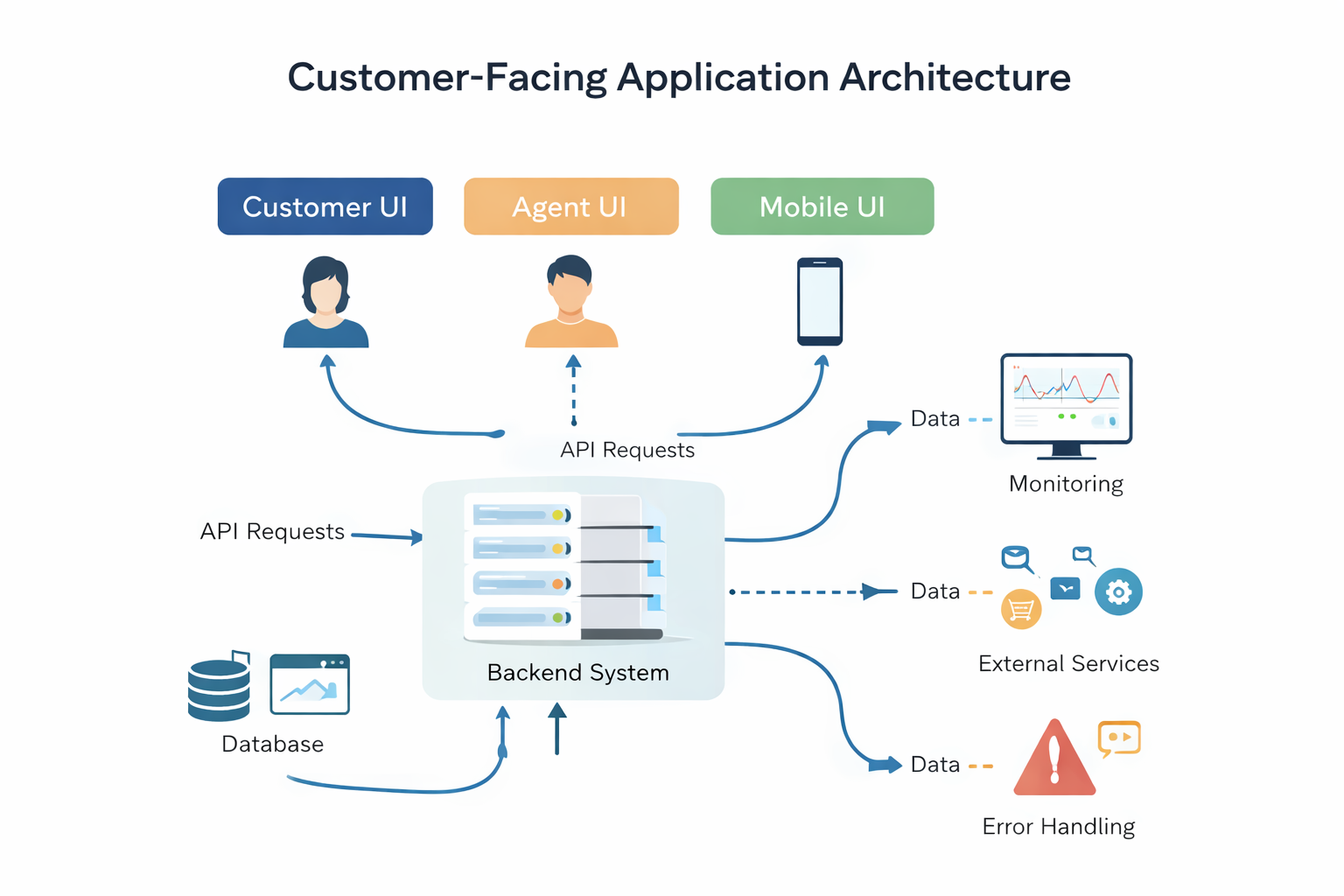
When I started learning full-stack development, my focus was simple, build features.
But working on real customer-facing applications changed how I think about software development completely.
Create a UI, write APIs, connect a database, and make everything work together.
And honestly, that’s how most of us begin.
But once I started working on real customer-facing applications, especially systems used by support teams and end users, I realized something important:
Building production systems is very different from just building features.
Over time, my understanding of development changed. It became less about writing code and more about building systems that actually work well in real-world conditions.
Here are some key things I learned along the way:
1. “It works” is not enough
Early in your journey, if something works locally, it feels like the job is done.
But in real applications, that’s just the starting point.
Once users start interacting with your system, new challenges appear:
- APIs fail or slow down
- unexpected inputs break flows
- edge cases appear everywhere
- users behave differently than expected
A feature is not complete when it works — it’s complete when it is reliable.
That means:
- proper error handling
- fallback mechanisms
- consistent responses
- thinking beyond the “happy path”
2. Users don’t care about your architecture
As developers, we often get excited about:
- clean architecture
- design patterns
- advanced implementations
But users don’t care about any of that.
They care about:
- how quickly they get what they need
- how easy the system is to use
- whether it solves their problem
While building customer-facing applications, I realized:
Simplicity beats complexity every time.
A simple, clear system that works reliably is far more valuable than a complex one that looks impressive.
3. Backend logic drives real impact
Frontend gets most of the attention, but in many real systems, the backend is where the real impact happens.
Things like:
- request routing
- prioritization logic
- integrations with external systems
- workflow automation
These directly affect:
- how fast teams can work
- how efficiently users are supported
Working on backend systems made me realize that small decisions in APIs or logic can have a large impact on overall operations.
4. Integrations are harder than they look
At first, integrations feel straightforward:
connect one system to another and exchange data.
In reality, they are much more complex.
You have to think about:
- data consistency
- failure handling
- retries and timeouts
- mismatched data formats
- system dependencies
And most importantly:
how that data will actually be used by real users or teams.
Integrations are not just technical — they are deeply connected to business workflows.
5. Scalability is more than handling traffic
When we hear “scalability”, we usually think about handling more users or requests.
But scalability also means:
- can the system evolve easily?
- can new features be added safely?
- can teams rely on it every day?
- is it easy to maintain?
A system that handles high traffic but is difficult to change or maintain is still not well designed.
6. Real users change how you think
One of the biggest shifts comes when real users start using your system.
You quickly see:
- what works
- what doesn’t
- what confuses users
- what actually helps
This feedback loop forces you to think differently.
You stop focusing only on code and start thinking about:
- usability
- reliability
- real-world impact
And that’s where real engineering growth happens.
Final Thoughts
Full-stack development gave me a strong foundation.
But working on customer-facing applications taught me something deeper:
Software is not just about building features.
It’s about building systems that solve real problems, reliably, clearly, and at scale.
That shift in mindset changed how I approach backend systems, integrations, and overall system design.
And honestly, it made development much more interesting.
For more blogs, click here.
To know about me, click here.
LinkedIn: click here.